

TL;DR
- Quick-connect tube fittings let you make and break a line in seconds without tools.
- Two main families dominate industrial work: dry-disconnect couplings (zero spillage) and shut-off couplings (auto-seal both sides).
- Swagelok carries the broadest stainless quick-connect range — 229 SKUs across the QM, QC, and QF series. Brass options cover lower-pressure utility work.
- Use quick-connects on test rigs, instrument cart connections, sample-port access, mobile equipment, and any line that gets connected and disconnected daily.
- Pick by pressure rating, body material, fluid compatibility, and the size of the line you are connecting.
Why quick-connects exist
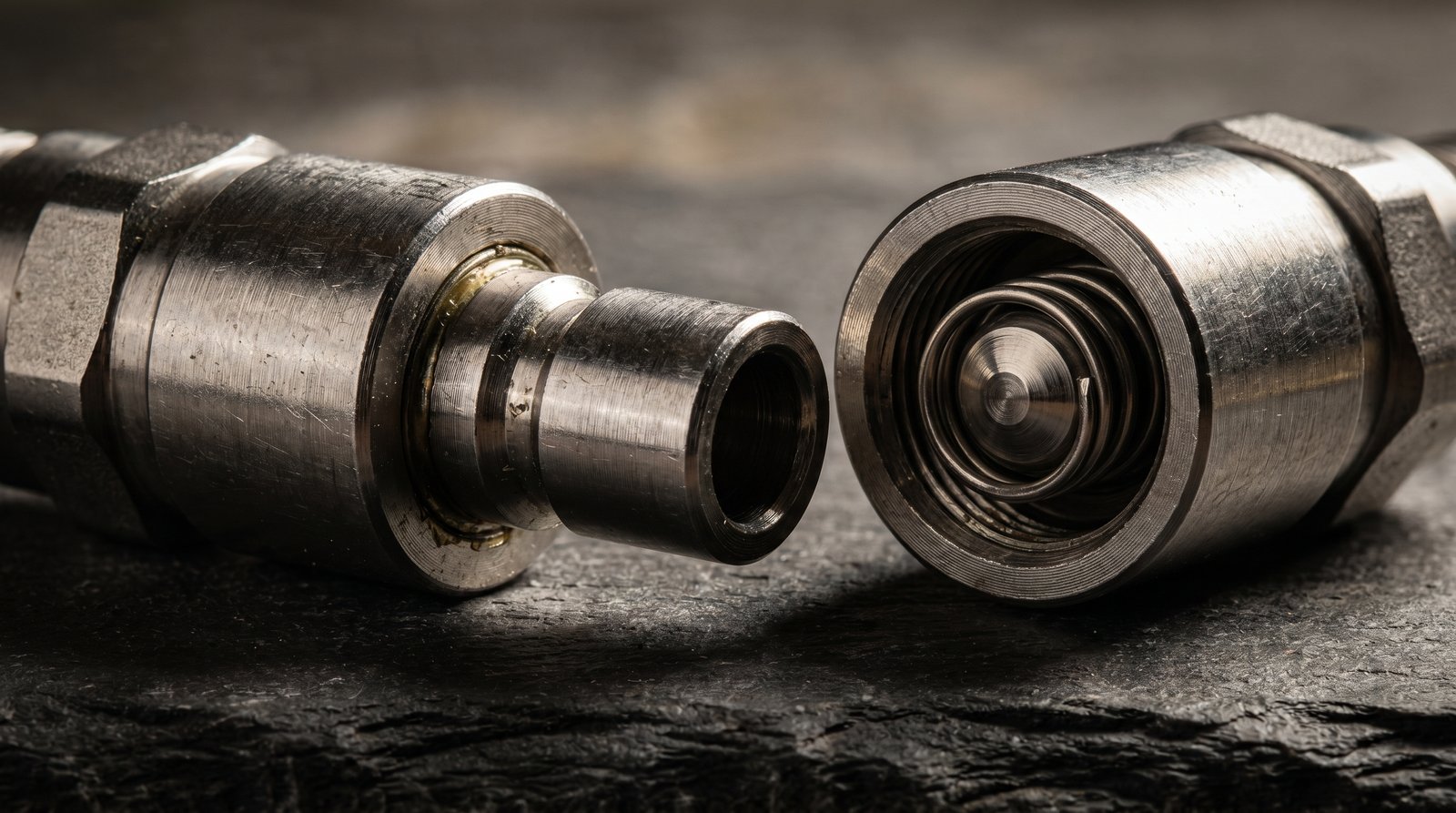
Permanent compression fittings live where the connection never breaks. Quick-connects live where it does — on test fixtures, calibration carts, leak-test panels, hose stations, and mobile equipment. Where a compression fitting takes a wrench, two ferrules, and a torque check, a quick-connect takes a press and a click.
The trade-off is pressure rating and ultimate seal integrity. A double-ferrule compression fitting routinely handles 6,000+ psi. A quick-connect tops out around 3,000-5,000 psi depending on the series. For permanent installation, stick with compression. For repeated connection cycles, quick-connect saves hours per shift.
The two families that handle most industrial work
- Dry-disconnect couplings. Both sides shut as the connection breaks. No fluid escapes. No air enters. Mandatory for hazardous chemistry, sample integrity work, and clean room service.
- Shut-off couplings. Each half has an internal spring-loaded poppet that closes when disconnected. Less expensive than full dry-disconnect, slightly more spillage at separation. Standard for hydraulic test work and utility air.
Picking the right quick-connect

- Match the body material to the fluid. 316L stainless covers most chemical and instrumentation service. Brass for clean water, instrument air, and most pneumatic work. Avoid brass on any chlorinated fluid.
- Confirm pressure rating. Most stainless quick-connects rate to 3,000-5,000 psi. Brass typically 500-1,500 psi. Always rate above the system relief setting.
- Verify the seal material. Buna-N for petroleum and most water. Viton for hot oil, fuels, and many solvents. Kalrez for aggressive chemistry. The wrong elastomer cracks under three weeks of service.
- Specify the connection style. Most quick-connect bodies accept compression, NPT, or BSP threads on the upstream side. Match to the line connection.
- Check the flow capacity. Quick-connects choke flow more than straight fittings. Verify the Cv passes the maximum operational flow.
Stainless steel vs brass — when each fits
- Stainless steel quick-connects handle chemical service, high-purity gas, instrumentation, and any application where corrosion or contamination matters. Higher upfront cost, longer service life.
- Brass quick-connects handle clean water, instrument air, pneumatic tooling, and low-pressure utility work. Lower cost, faster delivery, fine for non-corrosive service.
- Default to stainless when the fluid is anything other than air or clean water. The lifetime cost favors stainless on any aggressive service.
Common applications by industry

- Oil and gas: Hydraulic test panels, instrument calibration carts, sample ports.
- Chemical processing: Dry-disconnect couplings on hazardous-fluid transfer, CIP connections, batch reactor sample lines.
- Semiconductor: High-purity gas panel access, slurry sample lines, deionized water carts.
- Pharmaceutical: Sanitary quick-connects on batch transfer, clean-in-place loops, validation testing.
- Power generation: Steam-trap test points, lube-oil sampling, hydraulic actuator quick-fill.
- Lab and research: Gas chromatograph carrier connections, sample injection, vacuum test rigs.
Mistakes that ruin quick-connect service life
- Mixing brands at the coupling. Swagelok QF will not mate with Parker QC. Each manufacturer machines its own profile.
- Connecting under pressure. Many quick-connects require depressurized lines for engagement. Forcing engagement against system pressure damages the poppet and the o-ring.
- Wrong elastomer for the fluid. Buna-N on hot oil melts in days. Viton on amines breaks down in weeks. Always cross-check the seal material against the fluid.
- Skipping the wipe-down. Grit on the coupling face cuts the o-ring on engagement. A quick wipe with a clean cloth before connection extends seal life dramatically.
- Treating quick-connects as permanent. They are repeat-cycle devices. After 1,000-5,000 cycles, the seal needs replacement. Track cycle counts on high-use fixtures.
Inventory at Collins-Oliver
Our quick-connect coverage is widest on the Swagelok QM, QC, and QF series — 229 SKUs in stainless steel covering 1/4″ through 1/2″ line sizes, with body, stem, and full-coupling pairs. Brass options cover the standard pneumatic and clean-water service range. SSP and Parker coverage on selected sizes. Same-day pickup, nationwide shipping, no minimum order.
Frequently asked questions
What is a quick-connect tube fitting?
A quick-connect is a two-piece coupling that connects and disconnects a line in seconds, without tools. One side mounts to the line, the other to the matching half. Engagement is a push, a twist, or a sleeve pull depending on the design.
Can I connect a Swagelok quick-connect to a Parker quick-connect?
No. Each manufacturer uses proprietary engagement geometry and seal profiles. Stay within one brand for any coupling pair.
How much pressure can a quick-connect handle?
Stainless quick-connects typically rate 3,000-5,000 psi. Brass rates 500-1,500 psi. Specialty high-pressure series step higher. Always check the manufacturer’s data sheet against system maximum.
What is a dry-disconnect coupling?
A dry-disconnect coupling seals both halves as the connection breaks. No fluid escapes, no air enters. Standard for hazardous-fluid transfer and high-purity service.
How often should quick-connect seals be replaced?
Every 1,000-5,000 cycles depending on the fluid, pressure, and elastomer. Track the cycle count on high-use stations. Replace at any visible cracking, swelling, or extrusion of the seal.
Can quick-connects be used on chemical lines?
Yes, with the right body material and elastomer. 316L stainless body with Kalrez or Viton seals handles most chemical service. Always verify the fluid against the elastomer and body charts.
What is the difference between a quick-connect and a compression fitting?
A compression fitting is a permanent connection that takes wrenches and ferrules to install. A quick-connect engages and disengages by hand in seconds. Compression for permanent installation, quick-connect for repeat-cycle access.
How fast can Collins-Oliver ship quick-connect couplings?
Same-day pickup at our Baton Rouge facility on in-stock items. Nationwide shipping with no minimum order. We carry 229 Swagelok stainless quick-connect SKUs plus brass options.

Need quick-connect couplings today? Call Collins-Oliver or browse our tube-fitting inventory. Swagelok, SSP, and Parker quick-connects in stainless and brass — same-day pickup, no minimum order.