

TL;DR
- Parker and Swagelok both make double-ferrule compression fittings. They look similar, behave similarly, and do not interchange.
- Parker carries deeper per-SKU stock — 52,546 stainless ferrules in our warehouse. Swagelok carries broader SKU variety — 4,443 unique SKUs across the catalog.
- The fitting body, the front ferrule, and the back ferrule must all match brand. Mixing components fails leak testing.
- Pick by what your plant already runs. Don’t switch brands mid-system unless you replace the entire fitting train.
- Collins-Oliver stocks both brands in 316L stainless, brass, and exotic alloys with same-day shipping.
The cross-brand question every plant asks

Plants buy compression fittings by the thousands. When the inventory mix is half Parker and half Swagelok, the question keeps coming back: can the spare CPI ferrule go onto a Swagelok body? Quick answer: no. The geometries differ. The taper angle on the front ferrule, the back-ferrule capture, and the body shoulder profile all vary across brands. Combine them and the seal does not develop properly under pressure.
The fix is brand discipline. One brand per fitting. If the inventory crate has both, label them and keep them separated.
What each brand actually does well
- Parker. Massive inventory depth on the highest-volume SKUs. Ferrules, nuts, and unions in the 1/4″ through 1″ size band are stocked thousands deep. Best fit when you run a high-volume line at a single size and want the per-piece cost down.
- Swagelok. Broadest variant coverage. Every size, every material, every connection style, every metric and imperial variant exists in the catalog. Best fit when you need a specialty configuration or you cannot accept a substitute.
How a compression fitting actually seals
- The tube enters the fitting body and butts against the shoulder.
- The front ferrule rides up the tapered ramp inside the body.
- The back ferrule wedges between the front ferrule and the nut, pushing the front ferrule into the tube wall.
- Final torque drives the front ferrule into the tube wall and creates a metal-to-metal seal against the body.
- Pressure pushes the ferrule harder into both surfaces — the higher the pressure, the tighter the seal.
Mix a Parker ferrule with a Swagelok body and step 4 fails. The ramp angles do not match. Under pressure, fluid finds the geometry gap and leaks.
Pressure rating, temperature, and material
- Pressure: Both Parker and Swagelok stainless double-ferrule rate to 6,000+ psi at ambient on standard sizes. High-pressure series step to 10,000-15,000 psi.
- Temperature: 316L body and ferrules carry continuous service from cryogenic to 1,200°F. Brass to roughly 400°F. Verify against the published derating curve.
- Material match: Body and ferrules in the same grade. A 316 body with 304 ferrules under-performs in chloride service because the ferrule corrodes first.
- Tube hardness: The tube must be softer than the ferrule. Annealed 316L stainless takes the ferrule cleanly. Hardened tube cracks instead of deforming.
Installation discipline

- Cut the tube square. A skewed cut prevents the front ferrule from setting evenly.
- Deburr inside and out. A burr inside the tube traps debris that contaminates downstream equipment. A burr outside scores the ferrule on first set.
- Push the tube into the fitting body until it bottoms. Pull-back during torque leaves the front ferrule riding short of the tube wall.
- Finger-tighten the nut until snug, then torque 1-1/4 turns past finger-tight on first installation. Reassemblies use 1/4 turn past finger-tight from the original mark.
- Verify with a gap gauge or visual back-ferrule rotation. The back ferrule should rotate visibly during initial tightening — if it does not, the assembly is suspect.
Stock depth — what same-day actually means
“Same-day shipping” only matters when the inventory is real. The Collins-Oliver warehouse holds:
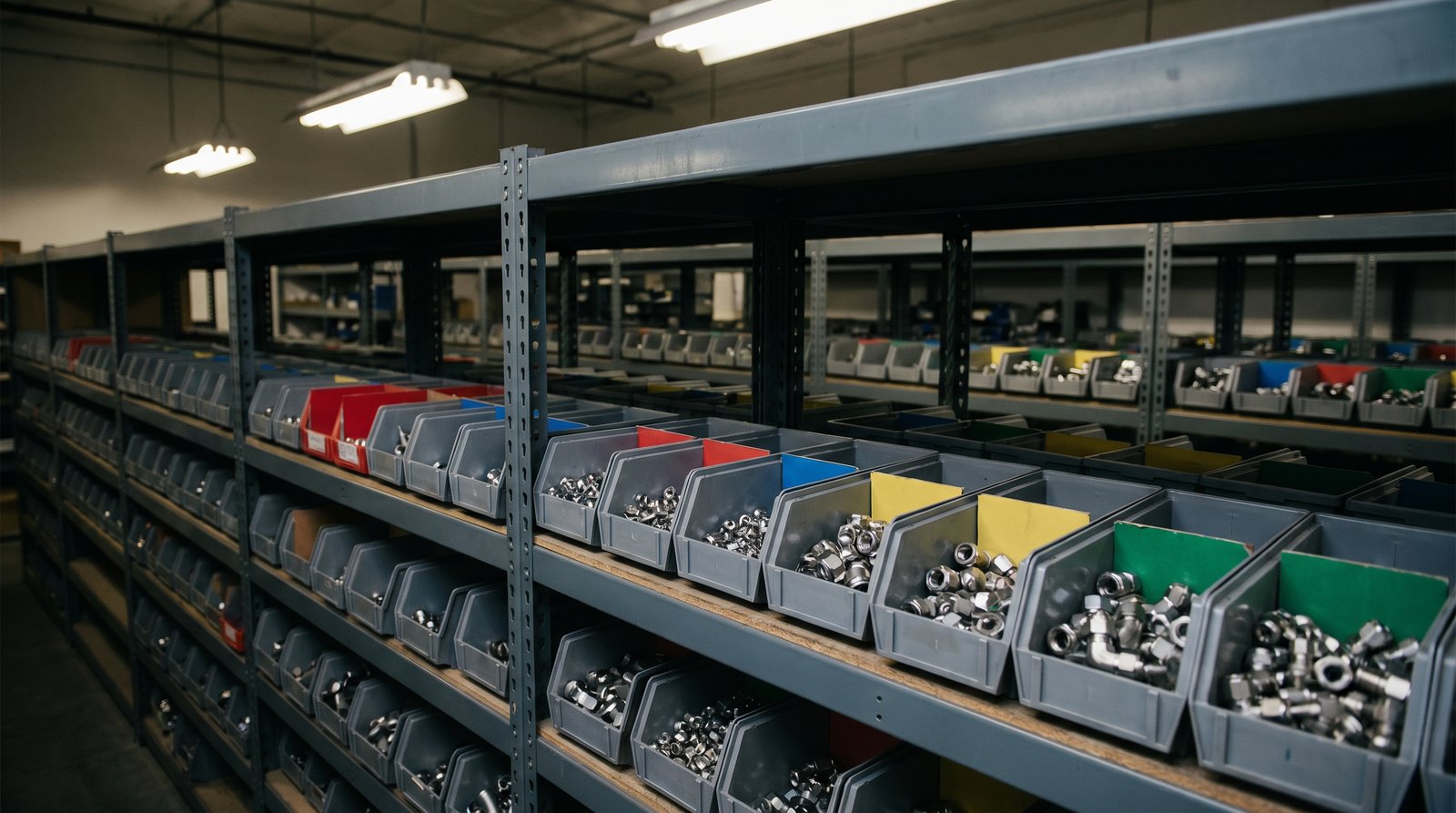
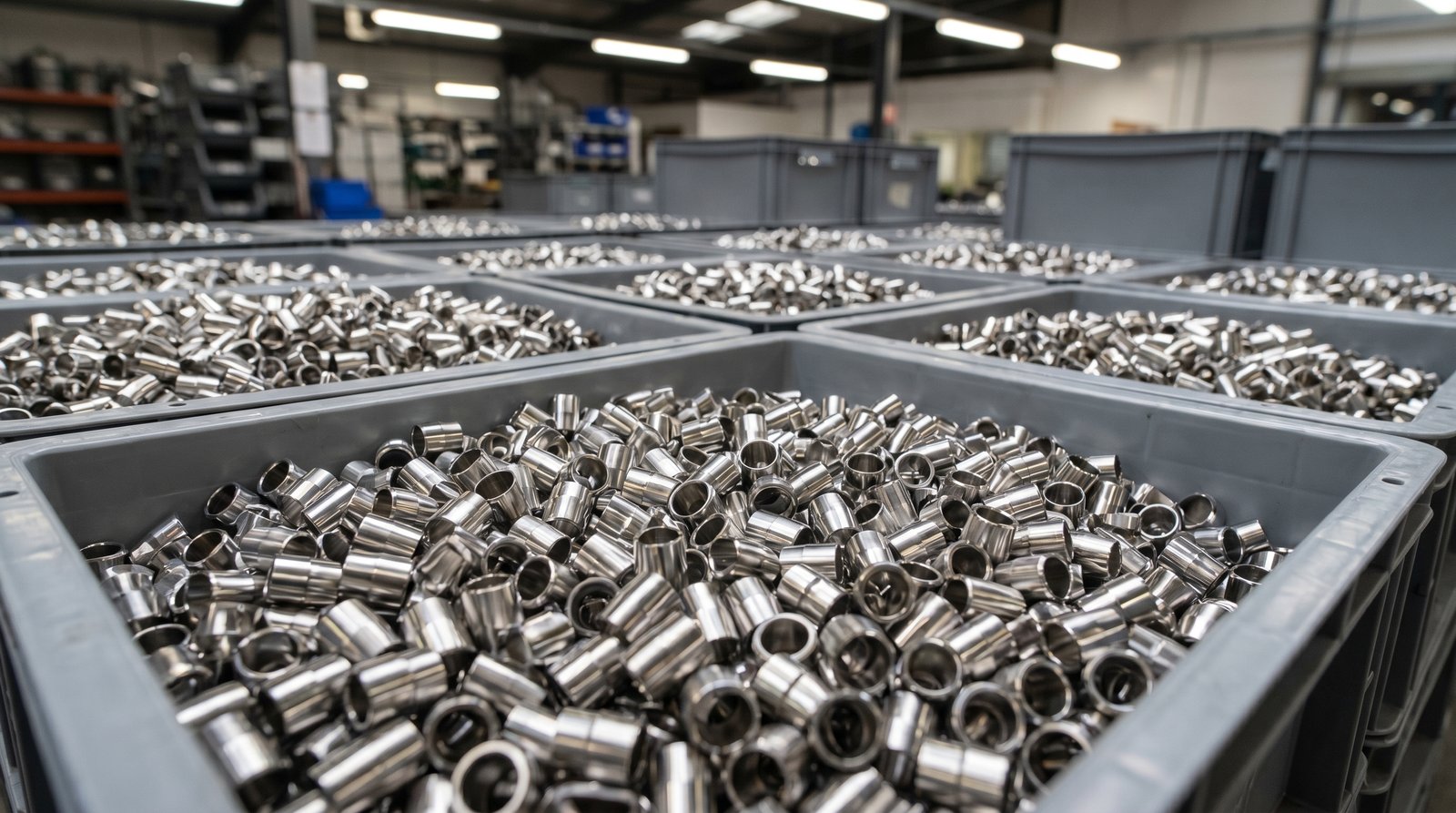
- Parker stainless ferrules: 52,546 pieces across 103 SKUs.
- Swagelok brass ferrules: 11,918 pieces across 118 SKUs.
- Parker total inventory: 182,834 pieces, 1,931 SKUs.
- Swagelok total inventory: 137,948 pieces, 4,443 SKUs.
That depth is what makes the same-day promise credible. When a plant calls for replacement ferrules at 7 AM, the order ships before lunch.
Mistakes that cause leaks
- Brand-mixing. The leading cause of compression-fitting leaks on the first pressure test. Audit the inventory and label every box.
- Over-torque. Past 1-1/4 turns the ferrule deforms past spec and damages the tube wall. The fitting may pass cold pressure test and leak under thermal cycling.
- Under-torque. Less than 1-1/4 turns leaves the ferrule riding short. Slow weeps appear under vibration.
- Re-using a single-use ferrule on a different tube. Once the front ferrule has bit into a specific tube, it does not seal cleanly against any other surface.
- Tube material harder than the ferrule. The ferrule cannot bite. Use annealed tube and verify hardness on the mill certification.
When to switch brands and when not to
Switching brands across an existing system is a rebuild project, not a substitution. You replace bodies, ferrules, and nuts at every joint. Leaving a single legacy joint in the other brand introduces a failure point that will not be obvious until the system is running.
For new builds, the right move is to pick one brand based on availability, cost-per-joint, and service support — then commit. Most B2B procurement teams pick Swagelok for instrumentation and Parker for hydraulics and pneumatics, but both brands serve both markets capably.
Frequently asked questions
Can I use a Parker ferrule on a Swagelok body?
No. The ferrule and body taper profiles differ between brands. Mixing them fails leak testing under pressure.
What is the difference between Parker CPI and Swagelok compression fittings?
Both are double-ferrule designs. The geometry differs: ramp angles, back-ferrule capture, and shoulder profile vary. They do not interchange.
How much should I torque a compression fitting?
First installation: 1-1/4 turns past finger-tight on standard sizes. Reassembly: 1/4 turn past finger-tight, measuring from the original tightened position.
What pressure can a Swagelok compression fitting handle?
Standard stainless rates to 6,000+ psi at ambient temperature. High-pressure series step to 15,000 psi. Always verify against the published data sheet for the specific size.
Why does my compression fitting leak after pressure testing?
Most likely causes, in order: brand-mixed components, under-torque, dirty or burred tube, hardened tube material, or damaged ferrule from a prior installation.
Can compression fittings be reused?
Yes — the same fitting on the same tube, at the same joint, retightens reliably. Reusing a ferrule on a different tube or in a different body fails.
Which material should I order for chloride service?
316L stainless minimum. For high-chloride or seawater service, step to Hastelloy C-276 or Monel 400. Verify against a compatibility chart.
How fast can Collins-Oliver ship compression fittings?
Same-day pickup at our Baton Rouge facility on in-stock items. Nationwide shipping with no minimum order. We carry Parker and Swagelok compression fittings in stainless, brass, and exotic alloys.
Need compression fittings today? Call Collins-Oliver or browse our tube-fitting catalog. Parker and Swagelok in 316L stainless, brass, and exotic alloys — same-day pickup, no minimum order.