TLDR: Choose your Swagelok union tee by tube OD and the connection required at each opening. You need a reducing tee when the tubing sizes differ, or a branch tee when the side connection must meet a threaded port.
Answer Target: Choose an equal-size union tee for matching tube ends, a reducing tee for different tube sizes, or a threaded branch tee when your tubing run connects to an instrument port.
How do you decode a Swagelok union tee number?
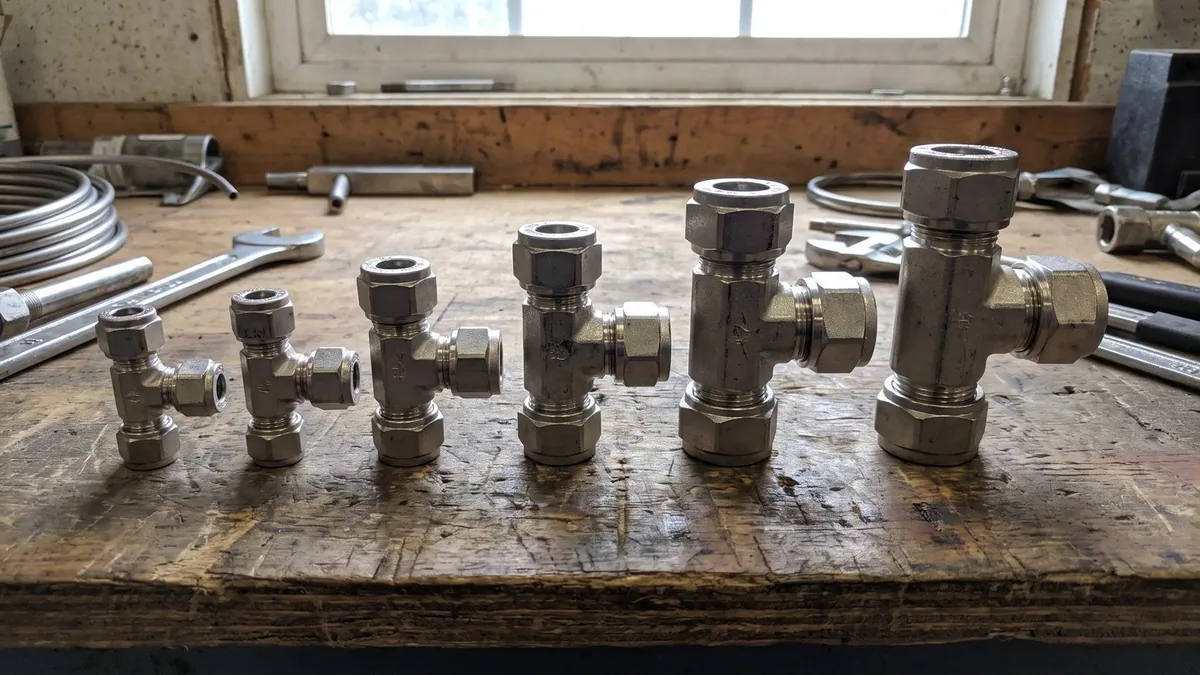
Expand your 400/3 or 810/3 shorthand into a complete ordering number. The complete ordering number is still required. For the stainless steel equal-size tees covered here, match those searches to SS-400-3 and SS-810-3, then confirm every connection before ordering.
Read your number in blocks. Read the material, tube size, series, component designation and fitting type in the Swagelok ordering-number guide. SS identifies 316 stainless steel, while the final -3 identifies the union tee in these equal-size examples.
Read your size block carefully. The manufacturer product pages linked below show you 400 for 1/4-inch tube OD, 600 for 3/8-inch, 810 for 1/2-inch, 1210 for 3/4-inch and 1610 for 1-inch. The block includes series and component digits, so treating the complete number as a dimension gives the wrong result.
Keep your full suffix intact. Moving from a plain -3 to a threaded tee designation changes your connection arrangement. Swagelok identifies TTM as male branch, TTF as female branch, TMT as male run and TFT as female run in its tee ordering information.
Which Swagelok union tee matches your tube OD?
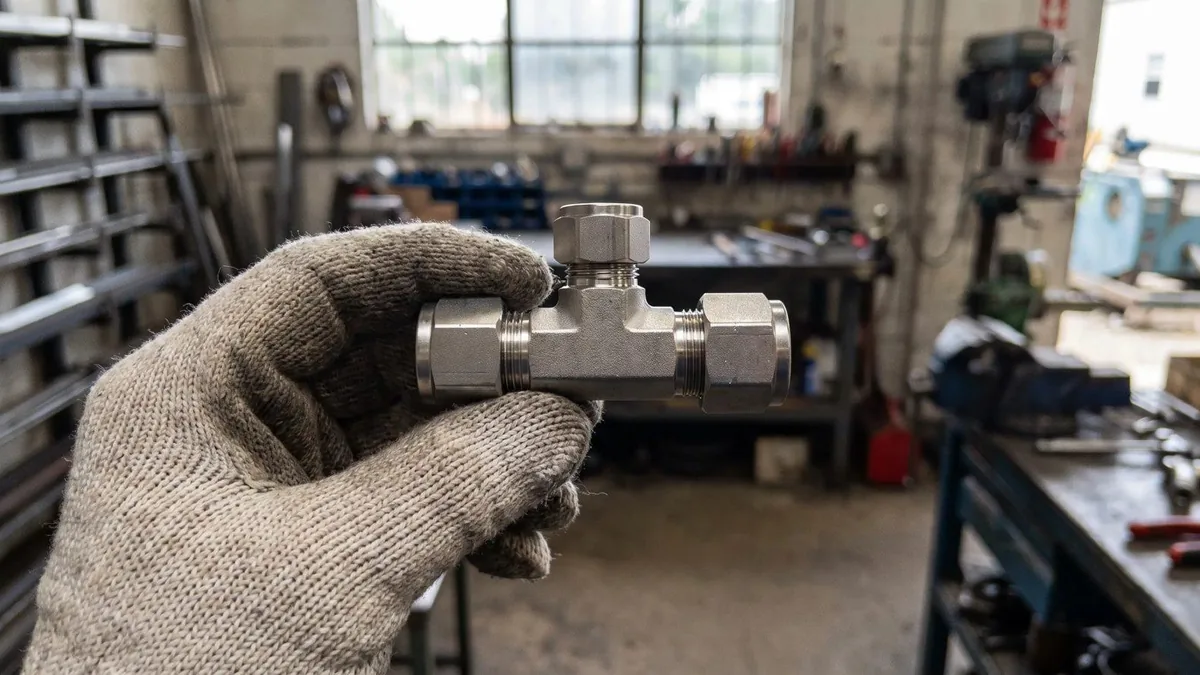
Start with your actual tubing size. Select your tube connection by the outside diameter, rather than the bore. Every connection size below comes from the linked Swagelok product page, with a separate Collins-Oliver link for the corresponding item.
| Collins-Oliver product | Run tube OD, each end | Branch tube OD | Manufacturer source |
|---|---|---|---|
| SS-400-3 union tee | 1/4 in. | 1/4 in. | SS-400-3 connection sizes |
| SS-600-3 tube tee | 3/8 in. | 3/8 in. | SS-600-3 connection sizes |
| SS-810-3 union fitting | 1/2 in. | 1/2 in. | SS-810-3 connection sizes |
| SS-1210-3 union tee | 3/4 in. | 3/4 in. | SS-1210-3 connection sizes |
| SS-1610-3 tube fitting | 1 in. | 1 in. | SS-1610-3 connection sizes |
| SS-600-3-6-4 reducing tee | 3/8 in. | 1/4 in. | SS-600-3-6-4 connection sizes |
Your table choice establishes the connection sizes. The purchase request still needs your tubing material, wall thickness and service requirements. Keep those details beside the part number so the buyer and installer work from the same specification, with the current drawing revision attached to the purchase request.
Check your replacement against the drawing. Determine which tubing ends stay in place and which sections will change. A familiar part number helps identify the fitting, but the finished assembly must still match the intended routing.
When does a reducing tee replace adapters?
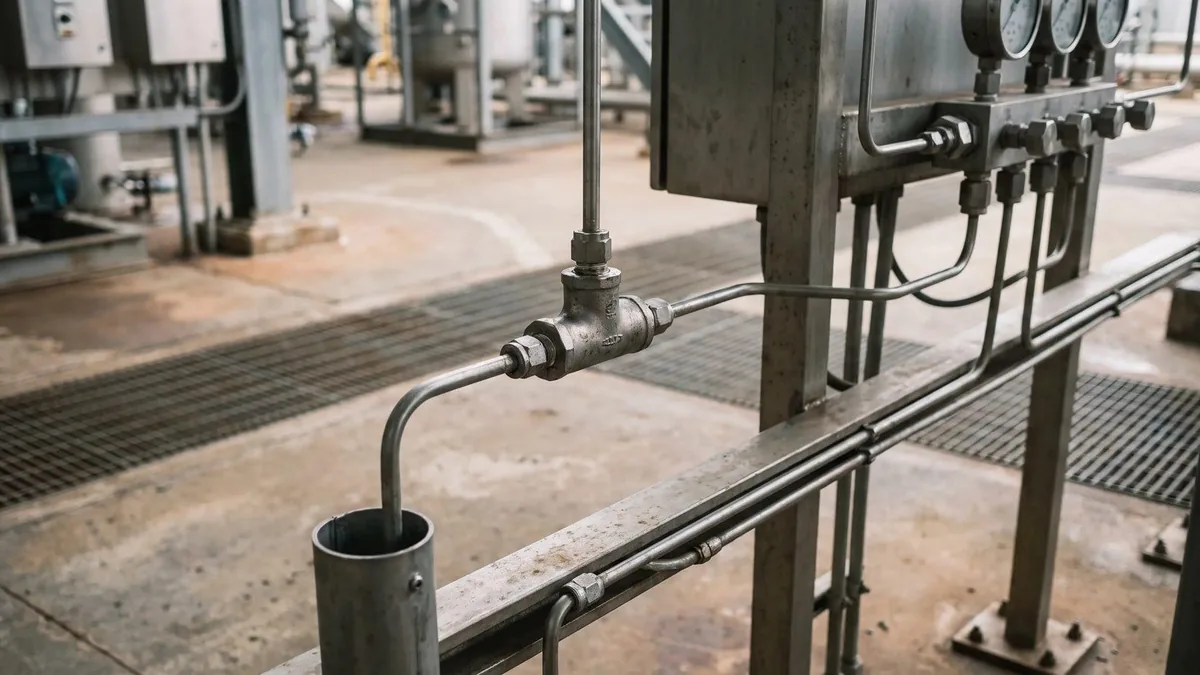
Choose the reduction at your junction. A direct match fits your junction when the main tubing stays the same size and the side tubing is smaller. The SS-600-3-6-4 product specification lists 3/8-inch tube connections at the run ends and a 1/4-inch tube connection at the branch.
Read your reducing number through its end. Identifying your arrangement requires both the run sizes and the branch size. In this example, 600 establishes the first tube size, -3 identifies the tee, and the trailing -6-4 specifies the remaining run and branch sizes, following the catalog’s run-then-branch ordering sequence.
Your alternative is an equal-size tee plus a reducer. The reducing tee lets you avoid the separate reducer at the branch when it already provides the required tube connection. Compare the complete assemblies for installation space, wrench access and the position of the smaller tube before changing the material list.
Keep your maintenance plan in view. Preserving existing tubing or a defined service break might require an adapter arrangement. Select the reducing tee when its integral size transition fits the drawing, then record the full number so a later reorder preserves the branch size.
Mark your proposed change on the sketch. Show the smaller tube leaving the branch and identify which existing components the reducing tee replaces. This gives the installer a clear assembly target and gives purchasing a complete replacement item rather than an isolated fitting description.
When is a branch tee the better pick?

Match your tee to the instrument port. A threaded branch tee fits your junction when the straight path carries tubing and the side connection mates directly with a threaded device. The SS-400-3TTM male branch tee has 1/4-inch tube connections on the run and a 1/8-inch male NPT branch.
Your mating thread determines the branch choice. Find the corresponding female arrangement in the SS-400-3TTF female branch tee, with 1/4-inch tube connections on the run and a 1/8-inch female NPT branch. These examples also show why the tube size alone does not establish the pipe-thread size.
Check your thread location next. Select a run tee when your threaded connection belongs on the straight path rather than the side branch. The manufacturer’s male and female tee drawings distinguish the TMT and TFT run arrangements from TTM and TTF branch arrangements.
Your branch tee replaces an adapter only when the connections match. Account for thread type, thread size, male or female orientation, and access around the instrument. Compare the complete layout before removing an adapter from the bill of materials, especially where its position supports instrument removal.
Keep your connection description explicit. Help purchasing by writing your run tube OD and branch thread designation beside the complete ordering number. A request reading only “stainless tee” leaves the most consequential selection details unresolved.
Sketch your instrument’s final position. Allow room to assemble your threaded connection and reach the tube nuts once the device is installed. If the direct branch arrangement obstructs the intended service access, retain a suitable adapter layout and document why it remains in the assembly.
What should you verify before ordering?
Your tee number is a starting point. Assessing your assembly also requires the tubing specification and operating conditions. Swagelok’s pressure-rating basis rates tube fitting ends to the working pressure of the tubing, so a standalone pressure figure beside a tee number does not establish your system rating.
Make your request easy to check. Describing your entire junction before selecting the item reduces ordering ambiguity. Include these details with the drawing or material list.
- Your full manufacturer part number and required quantity.
- Your tube OD at each run end and at the branch.
- Your tubing material, wall thickness and service conditions.
- Your thread designation and male or female connection, where applicable.
- Your layout, access constraints and required pickup or shipping date.
Plan your installation before opening the line. Depressurize your system before disassembly or adjustment, and Swagelok warns against bleeding pressure by loosening a fitting nut. Follow the catalog’s installation precautions and keep the specified fitting components together.
Keep your field notes with the order. Flag any difference between your installed tubing and the drawing before approving a replacement. Resolve the connection arrangement first, then carry the confirmed description into the purchase request and the installation work package.
Check your receipt against that request. Match your selected configuration with the complete part number, including the reducing or threaded suffix. Keep any proposed substitution separate from the accepted material list until its connection arrangement has been checked against the job requirements.
Get your tee through Collins-Oliver
Bring your complete part number. You have access to Collins-Oliver’s stock depth of over 19,000 part numbers, with same-day pickup in Baton Rouge and nationwide shipping. Start with the tee product selection, then discuss the required item and quantity with a person who knows the part.
Put your schedule on the request. You should identify the exact tee, the quantity needed and whether pickup or shipment fits the job. Confirm availability for the specific item so the material list supports the work schedule.
Send your drawing with the request. You give the conversation a clear reference when the run, branch and threaded port are labeled. For a Gulf Coast maintenance job or an instrumentation package shipping elsewhere, a complete connection description keeps the discussion focused on the required part.
Explain your replacement objective at the start. You might be matching an existing junction, reducing the branch tubing size or connecting a threaded instrument directly. Sharing that objective helps the parts conversation address the assembly you need to build.
What else do buyers ask about these tees?
Does a union tee split flow equally?
Your tee connection sizes do not establish an equal flow split. The manufacturer’s product specification lists connection sizes and body material for your fitting. Treat flow balancing as a separate system requirement.
How do I identify a metric Swagelok tee?
Check your fitting’s markings. You should look for the MM stamp on metric shaped fittings such as tees, as described in the metric fitting identification guidance. Confirm the complete ordering number instead of selecting a fractional replacement by appearance.
Do I need thread sealant on the NPT branch?
Your tapered pipe-thread connection needs appropriate thread sealant. You will find this requirement in Swagelok’s pipe-thread sealant instructions. Distinguish the NPT joint from the tube fitting connection when preparing the assembly.
Is a gap gauge for initial assembly or reassembly?
Your gap gauge checks sufficient tightening on initial installation. You should follow the separate reassembly procedure after taking a fitting apart, because Swagelok says not to apply the gap inspection gauge to reassembled fittings. Both procedures appear in the installation and reassembly instructions.
Does the standard tee include special cleaning?
Your cleaning requirement needs its own check. You will see Standard Cleaning and Packaging (SC-10) on the SS-600-3 specification. State any different project cleaning requirement explicitly when requesting the part.
Will a tee solve a scratched tube connection?
Inspect your tubing before replacing the fitting. You need to address surface damage because Swagelok identifies scratches and other tubing defects as obstacles to sealing in its tubing considerations. A replacement tee does not establish the condition of the tube entering it.
Ready to specify your tee? Call (800) 247-5756 or request a quote. Have the full part number ready when you call.
Want more of this in your Google feed? Tap here and Google shows you our articles first.